Short vertical antennas are considered to be any antenna that is less than a 1/4 wavelength tall in size. O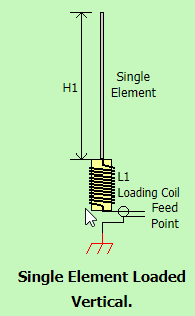 ne of the ways to make such a vertical is to introduce loading coils within the vertical element itself. Most low-band verticals (80-10 meters) have loading coils physically located at the base of the antenna, considered as a single element vertical, which is the least efficient. But to make a vertical that is less than a 1/4 wavelength of the desired operating frequency work more efficiently, the loading could would be moved up to the middle of the vertical element or at the top for maximum efficiency. Antennas that have loading coils situated in the middle of the vertical element is considered a double-element vertical. It is also true with any 1/4 wavelength vertical element, ground radials are a must. If you double the length of the element, making it a 1/2 wavelength antenna of the operating frequency, no radials are required.A quarter-wavelength antenna is easy and inexpensive to build and can be an effective antenna with a low angle of radiation (that is, power is radiated out, not up).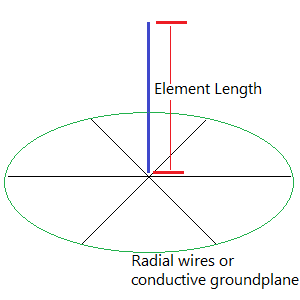
The formula for calculating the approximate length of a quarter-wave:
Quarter-wavelength in meters: 71.5 / frequency in MHz
Half-wavelength in feet: 468 / frequency in MHz
Half-wavelength in meters: 143/ frequency in MHz
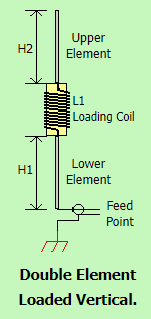
The closer you get the loading coil toward the top on a shortened antenna (all of them are for mobile) the more RF current will radiate toward the top giving a significant advantage on short antennas.
Another trick to these type of antennas is what’s called a capacitance hat on the top but I’m not sure if any mobile whip antennas are sold with them that aren’t just an accessory gimmick and plus having both a cap hat and loading coil near the top brings issues with weight and whipping the antenna around more in wind.